Microsoft - AB-731: AI Transformation Leader
Sample Questions
Question: 109
Measured Skill: Identify an implementation and adoption strategy for Microsoft’s AI apps and services (20–25%)
Select the answer that correctly completes the sentence.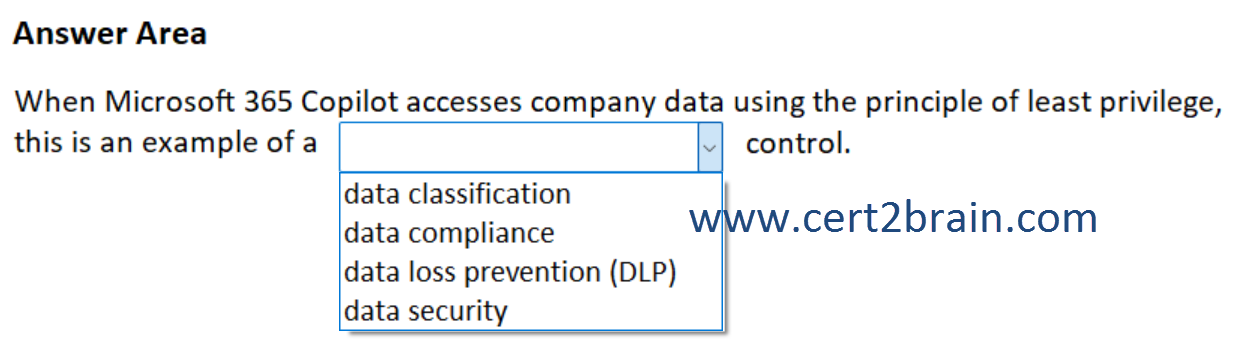
| A | When Microsoft 365 Copilot accesses company data using the principle of least privilege, this is an example of a data classification control. |
| B | When Microsoft 365 Copilot accesses company data using the principle of least privilege, this is an example of a data compliance control. |
| C | When Microsoft 365 Copilot accesses company data using the principle of least privilege, this is an example of a data loss prevention (DLP) control. |
| D | When Microsoft 365 Copilot accesses company data using the principle of least privilege, this is an example of a data security control. |
Correct answer: DExplanation:
The principle of least privilege means that Microsoft 365 Copilot can access only the data a user is explicitly permitted to access. This is a core data security control, because it enforces access restrictions and minimizes the risk of unauthorized data exposure.
Copilot inherits Microsoft Entra ID permissions and respects SharePoint, OneDrive, Exchange, and Teams access controls. Copilot cannot surface data the user doesn’t already have permission to see.
References:
Data, Privacy, and Security for Microsoft 365 Copilot
Enterprise data protection in Microsoft 365 Copilot and Microsoft 365 Copilot Chat
Question: 110
Measured Skill: Identify an implementation and adoption strategy for Microsoft’s AI apps and services (20–25%)
A retail company wants to use AI to forecast seasonal demand for its product lines using five years of historical sales data. A separate team wants to use AI to generate personalised marketing emails based on customer purchase history.
Which types of AI are most appropriate for each use case?| A | Generative AI for both demand forecasting and email generation |
| B | Machine learning for demand forecasting and generative AI for personalised email generation |
| C | Generative AI for demand forecasting and machine learning for email generation |
| D | Predictive analytics for both use cases |
Correct answer: BExplanation:
Demand Forecasting → Machine Learning
The company wants to analyze five years of historical sales data to predict future seasonal demand. This is a classic machine learning (predictive analytics) use case because the AI learns patterns from historical data and makes forecasts about future outcomes.
Examples:
- Sales forecasting
- Demand prediction
- Inventory optimization
- Churn prediction
Personalized Marketing Emails → Generative AI
The marketing team wants AI to create personalized email content for customers based on purchase history. Generative AI is designed to generate new content such as text, emails, product descriptions, and marketing messages.
Examples:
- Writing personalized emails
- Generating marketing copy
- Creating product descriptions
- Drafting customer communications
References:
Introduction to machine learning concepts
Generative AI
Question: 111
Measured Skill: Identify the business value of generative AI solutions (35–40%)
A legal services firm wants to deploy an AI assistant that answers employee questions about the firm's internal policies and procedures. The firm operates in a highly regulated industry with specialised legal terminology.
A pretrained large language model produces responses that are generally accurate but frequently uses incorrect legal terms and occasionally misinterprets the firm's specific compliance requirements.
What should the firm do?| A | Replace the large language model with a smaller, cheaper model to reduce costs. |
| B | Fine-tune the model on the firm's internal documentation and legal terminology to improve domain- specific accuracy. |
| C | Continue using the pretrained model and instruct employees to verify all responses manually. |
| D | Abandon the AI assistant project because pretrained models cannot handle specialised domains. |
Correct answer: BExplanation:
fine-tuning adapts a pretrained model to perform better on a specific task, dataset, or domain by training it with domain-specific data. Fine-tuning is particularly useful when you need the model to understand specialized terminology, industry-specific concepts, organizational policies, or unique compliance requirements.
In this case, training the model on:
- Internal policy documents
- Firm compliance guidance
- Legal terminology and procedures
would help the model generate more accurate, domain-appropriate responses.
Reference: Model fine-tuning concepts
Question: 112
Measured Skill: Identify the business value of generative AI solutions (35–40%)
A mid-sized company wants to give all 500 employees access to AI assistance. The company uses Microsoft 365 E3 but has not purchased any additional AI licences.
The CEO wants to understand the difference between the free Microsoft Copilot available to all employees and the paid Microsoft 365 Copilot add-on before approving the budget.
What is the key difference between these two products?| A | Microsoft 365 Copilot is faster but otherwise identical to the free Microsoft Copilot. |
| B | The free Microsoft Copilot uses internet data only, while Microsoft 365 Copilot accesses organisational data through Microsoft Graph, enabling it to work with the company's emails, documents, meetings, and contacts. |
| C | The free Microsoft Copilot works in all Microsoft 365 apps, while Microsoft 365 Copilot is limited to Teams. |
| D | There is no meaningful difference; the free version provides the same functionality. |
Correct answer: BExplanation:
The key differentiator of Microsoft 365 Copilot is its integration with Microsoft Graph, which provides access to a user's organizational data (subject to existing permissions) such as:
- Emails (Outlook)
- Documents (SharePoint, OneDrive)
- Teams chats
- Meetings and transcripts
- Calendar information
- Contacts and organizational context
This allows Microsoft 365 Copilot to generate responses grounded in your company's data and workflows.
target="_blank">Expand the knowledge of Microsoft 365 Copilot with Microsoft Graph
Question: 113
Measured Skill: Identify an implementation and adoption strategy for Microsoft’s AI apps and services (20–25%)
A pharmaceutical company is establishing an AI council to oversee AI deployment across the organisation. The company is subject to strict regulatory requirements and operates in 30 countries. The CEO wants to know who should sit on the council.
Which composition ensures effective governance for this organisation?| A | The CTO and the IT department heads only, since AI is a technology initiative. |
| B | A cross-functional council including an executive sponsor, legal and compliance representatives, IT and security leaders, business unit representatives, ethics and privacy experts, and employee representatives. |
| C | An external consulting firm hired to manage all AI governance decisions. |
| D | The data science team, since they have the deepest understanding of AI technology. |
Correct answer: BExplanation:
The company operates in a highly regulated industry (pharmaceuticals) and across 30 countries, which means AI governance must address not only technology, but also:
- Regulatory compliance
- Legal requirements
- Privacy and data protection
- Security
- Ethical considerations
- Business objectives
- Employee adoption and impact
Industry guidance consistently recommends a cross-functional AI governance council that brings together executive, legal, compliance, security, technical, and business stakeholders to provide effective oversight and responsible AI governance.
Reference: Guidance to set up your organization's AI governance process