Microsoft - DP-900: Microsoft Azure Data Fundamentals
Sample Questions
Question: 337
Measured Skill: Describe considerations for working with non-relational data on Azure (15–20%)
Select the answer that correctly completes the sentence.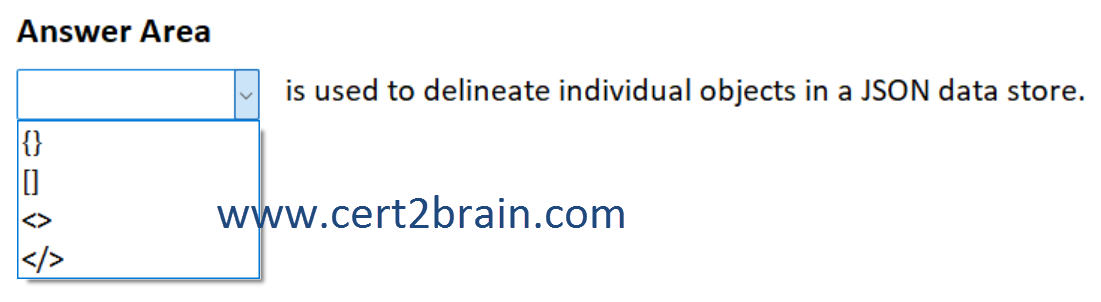
| A | {} is used to delineate individual objects in a JSON data store. |
| B | [] is used to delineate individual objects in a JSON data store. |
| C | <> is used to delineate individual objects in a JSON data store. |
| D | </> is used to delineate individual objects in a JSON data store. |
Correct answer: AExplanation:
In JSON, curly braces {} are used to define an object.
For example:
{

"name": "User1",

"phone": "111-111"

}
Reference: Introducing JSON
Question: 338
Measured Skill: Describe considerations for working with non-relational data on Azure (15–20%)
What is an example of rehydrating a blob in an Azure Storage account?| A | Appending data to a blob |
| B | Changing the access tier of a blob from Archive to Cool |
| C | Splitting a blob into multiple files |
| D | Changing the access tier of a blob from Cool to Archive |
Correct answer: BExplanation:
To read a blob that is in the archive tier, you must first rehydrate the blob to an online (hot, cool, or cold) tier. You can rehydrate a blob in one of two ways:
- By copying it to a new blob in the hot, cool, or cold tier with the Copy Blob operation.
- By changing its tier from archive to hot, cool, or cold tier with the Set Blob Tier operation.
When you rehydrate a blob, you can specify the priority for the operation to either standard priority or high priority. A standard-priority rehydration operation may take up to 15 hours to complete. A high-priority operation is prioritized over standard-priority requests and may complete in less than one hour for objects under 10 GB in size. You can change the rehydration priority from Standard to High while the operation is pending.
Reference: Rehydrate an archived blob to an online tier
Question: 339
Measured Skill: Describe an analytics workload on Azure (25–30%)
For each of the following statements, select Yes if the statement is true. Otherwise, select No.
(NOTE: Each correct selection is worth one point.)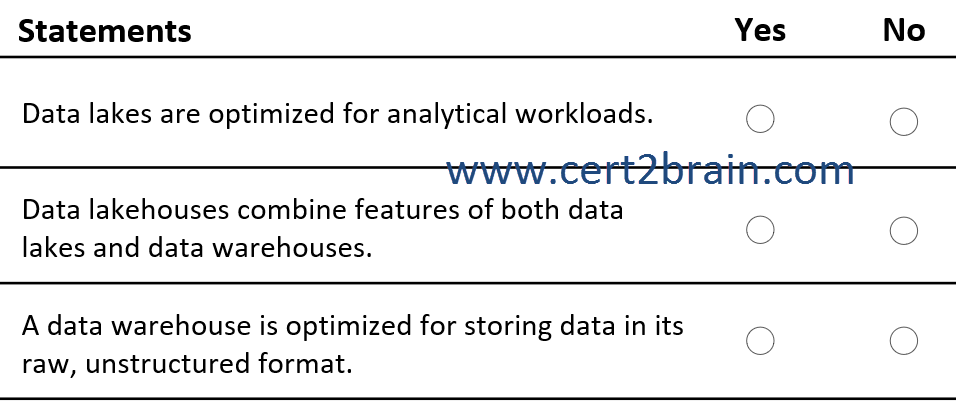
| A | Data lakes are optimized for analytical workloads: Yes
Data lakehouses combine features of both data lakes and data warehouses: Yes
A data warehouse is optimized for storing data in its raw, unstructured format: Yes |
| B | Data lakes are optimized for analytical workloads: Yes
Data lakehouses combine features of both data lakes and data warehouses: Yes
A data warehouse is optimized for storing data in its raw, unstructured format: No |
| C | Data lakes are optimized for analytical workloads: Yes
Data lakehouses combine features of both data lakes and data warehouses: No
A data warehouse is optimized for storing data in its raw, unstructured format: Yes |
| D | Data lakes are optimized for analytical workloads: No
Data lakehouses combine features of both data lakes and data warehouses: Yes
A data warehouse is optimized for storing data in its raw, unstructured format: Yes |
| E | Data lakes are optimized for analytical workloads: No
Data lakehouses combine features of both data lakes and data warehouses: No
A data warehouse is optimized for storing data in its raw, unstructured format: Yes |
| F | Data lakes are optimized for analytical workloads: No
Data lakehouses combine features of both data lakes and data warehouses: No
A data warehouse is optimized for storing data in its raw, unstructured format: No |
Correct answer: BExplanation:
Data lakes are designed to store large volumes of structured, semi-structured, and unstructured data for analytics, machine learning, and big data processing.
A data lakehouse combines the flexibility and low-cost storage of a data lake with the management, performance, and querying capabilities of a data warehouse.
Data warehouses are optimized for structured, curated, and transformed data used for reporting and analytics. Storing raw, unstructured data is typically the role of a data lake.
Reference: What is a Data Lake?
Question: 340
Measured Skill: Describe core data concepts (25–30%)
Match the data terms to the appropriate descriptions.
(To answer, drag the term from the column on the left to its description on the right. Each term may be used once, more than once, or not at all. NOTE: Each correct match is worth one point.)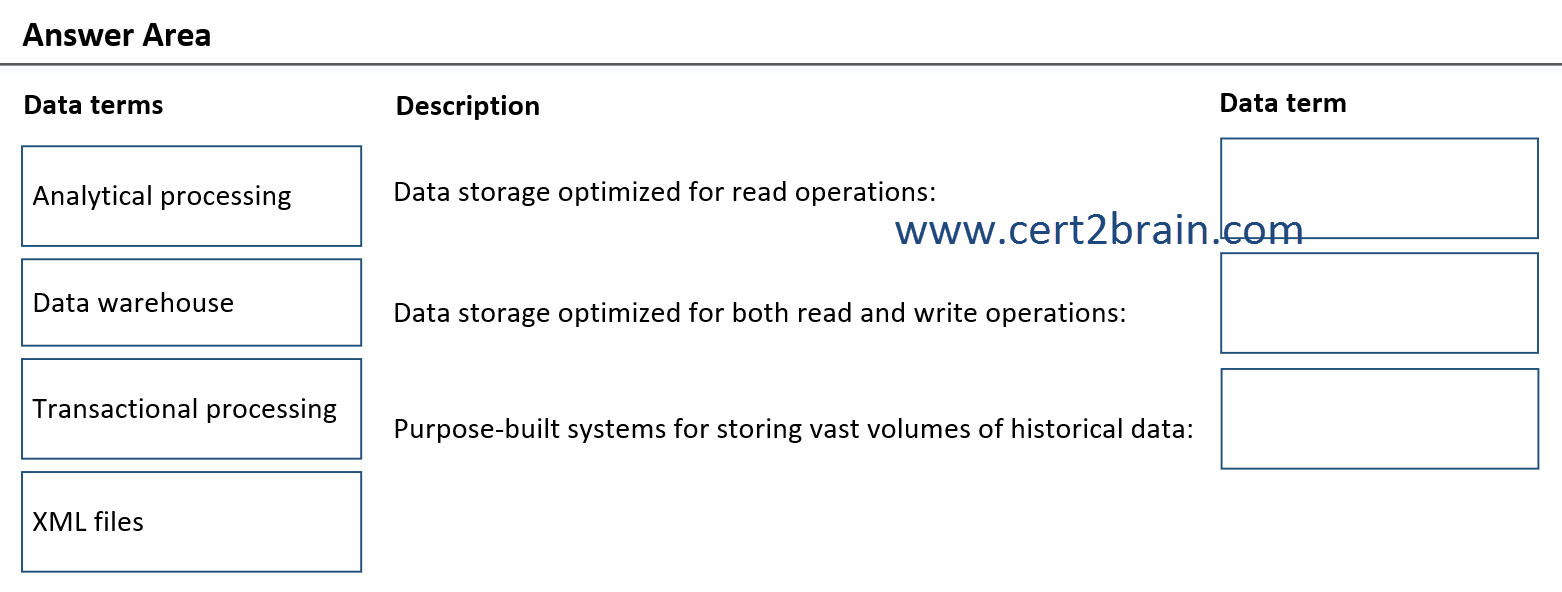
| A | Data storage optimized for read operations: Analytical processing
Data storage optimized for both read and write operations: XML files
Purpose-built systems for storing vast volumes of historical data: Transactional processing |
| B | Data storage optimized for read operations: Data warehouse
Data storage optimized for both read and write operations: Transactional processing
Purpose-built systems for storing vast volumes of historical data: XML files |
| C | Data storage optimized for read operations: XML files
Data storage optimized for both read and write operations: Analytical processing
Purpose-built systems for storing vast volumes of historical data: Data warehouse |
| D | Data storage optimized for read operations: XML files
Data storage optimized for both read and write operations:
Purpose-built systems for storing vast volumes of historical data: Analytical processing |
| E | Data storage optimized for read operations: Analytical processing
Data storage optimized for both read and write operations: Transactional processing
Purpose-built systems for storing vast volumes of historical data: Data warehouse |
| F | Data storage optimized for read operations: Transactional processing
Data storage optimized for both read and write operations: Data warehouse
Purpose-built systems for storing vast volumes of historical data: XML files |
Correct answer: EExplanation:
Analytical processing
Processing and analyzing large volumes of data to identify trends, patterns, and insights for reporting and decision-making. Analytical systems are typically optimized for read operations.
Data warehouse
A centralized repository that stores large amounts of structured historical data from multiple sources. Data warehouses are designed for analytics, reporting, and business intelligence.
Transactional processing
Processing day-to-day business transactions such as sales, orders, and banking operations. Transactional systems are optimized for both read and write operations and support many concurrent users.
XML files
Files that store data in Extensible Markup Language (XML) format. XML uses tags to define and organize structured data, making it easy to exchange information between different systems and applications.
References:
Online analytical processing
Online transaction processing (OLTP)
What is a data warehouse?
XML for the uninitiated
Question: 341
Measured Skill: Describe an analytics workload on Azure (25–30%)
You need to implement a visual that will display the stages of a sales pipeline and the number of leads from each stage.
Which type of visual should you use?| A | Ribbon chart |
| B | Decomposition tree |
| C | Funnel chart |
| D | Area chart |
Correct answer: CExplanation:
A funnel chart helps you visualize a linear process that has sequential, connected stages. A common use for a funnel chart is to track sales customers through stages, such as Lead > Qualified Lead > Prospect > Contract > Close. At a glance, the shape of the funnel conveys the health of the process you're tracking.
Each funnel stage represents a percentage of the total. In most cases, a funnel chart is shaped like a funnel where the first stage is the largest and each subsequent stage is smaller than its predecessor. A pear-shaped funnel is also useful and can help identify a problem in the process. Typically, the first stage (called the intake stage) is the largest.
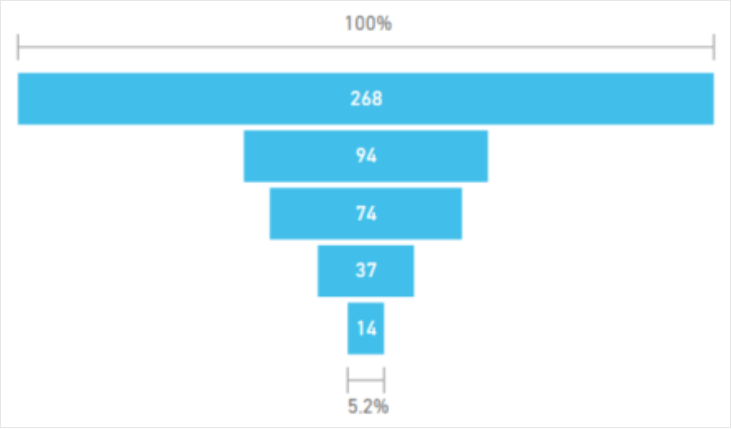
Funnel charts support many capabilities, such as sorting and displaying multiples. You can highlight and cross-filter data in a funnel chart by selecting data on other visualizations on the same report page and vice versa.
Reference: https://learn.microsoft.com/en-us/power-bi/visuals/power-bi-visualization-funnel-charts